



Aerospace engineers design, test, and supervise the manufacture of aircraft, spacecraft, and missiles. In addition, they develop new technologies for use in aviation, defense systems, and space exploration.
The field is divided into two areas of focus: vehicles that fly within the Earth’s atmosphere (aeronautics) and vehicles that fly in space (astronautics).
Because of the sophistication of today’s aircraft, rockets, and spacecraft, it takes a team of engineers from many different disciplines to build these vehicles. For example, a mechanical engineer might design the engine, a civil engineer would design the structure and a computer engineer would develop the flight control computer. In reality, all these disciplines will contribute to the whole process.
What makes it unique? Aerospace vehicles contain many different systems, such as communication, navigation, radar, and life support. Working on large scale projects involves many component parts and systems and lots of professionals working in sync. This is also a field where engineers can make a big difference in terms of environmental impact as they improve products and systems.
Explore
Degree Connections
The following are examples of some accredited degrees leading to a career in Aerospace Engineering:
- Aerospace Engineering
- Aeronautical Engineering
- Mechanical Engineering
- Materials Engineering
- Civil Engineering
- Computer Engineering
- Electrical Engineering
- Software Engineering
Search our global database of accredited engineering programs.
Want to learn more? Click on the blue tabs to explore the field in more detail and learn about preparation and employment, the green tabs to be inspired by people working in aerospace engineering and how they impact the world, and the orange tabs for ideas on how to learn more and you can get involved with activities, camps, and competitions!
A Day in the Life

1bigstock.com/vitanovski
Aerospace engineers work full time, sometimes in office environments, sometimes at testing or launch sites. They often specialize in areas such as aerodynamic fluid flow; structural design; guidance, navigation, and control; instrumentation and communication; robotics; and propulsion and combustion. This will impact their workspace.
Because teamwork is such a big part of engineering, they will likely work on a team with other engineers from the same and other fields. The development of a rocket to carry people and experiments to space is a team effort! Engineers who direct projects must often work extra hours to monitor progress, to ensure that designs meet requirements, to determine how to measure aircraft performance, to see that production meets design standards, to participate in test flights and first flights, and to ensure that deadlines are met.
Aerospace engineers might be working on a new effort, such as developing a spacecraft that would be able to land on an asteroid, or working to improve the efficiency of an airplane to help reduce its impact on the environment. So problems and challenges may change day to day or project to project. Unlike some fields, where the type of work and challenges are similar day to day, for an engineer, the challenges are different every day, and errors or unexpected changes to a project may require people to change strategy and start again. Flexibility is a big part of any engineering effort.
Historical Snapshot
International Space Station:
The International Space Station (ISS) is a modular space station residing in low Earth orbit. It took a decade and 30+ missions to deliver and assemble. It is the result of unprecedented scientific and engineering collaboration among five participating space agencies: NASA (United States), Roscosmos (Russia), JAXA (Japan), ESA (Europe), and CSA (Canada). The station serves as research laboratory for many fields and has contributed to advances in environmental protection, medicine, and physics. A few fun facts:
- since it opened, ISS astronauts have conducted about 3,000 science experiments, so far!
- 241 individuals from 19 countries have visited the ISS.
- It has been continuously occupied since November 2000.
- It is larger than a six-bedroom house.
- Eight miles of wire connects the electrical power system aboard the space station.
Needless to say, mechanical engineers have made great progress in improving the efficiency of these machines that have allowed buildings all over the world to be able to rise further into the sky. (There is a limit to how many flights of stairs people are willing to climb!)
Explore the history:
Industries and Employment

2bigstock.com/Zenobillis
Aerospace engineers typically are employed in the aerospace product and parts industry, although their skills are becoming increasingly valuable in other fields. For example, in the motor vehicles manufacturing industry, aerospace engineers design vehicles that have lower air resistance and, thus, increased fuel efficiency.
In terms of global employment, most aerospace engineers work in the areas of national defense, or related projects or the design of civilian aircraft and space vehicles. Research-and-development projects, especially related to improving the safety, fuel efficiency, and environmental impact of flight, are a large focus of aerospace engineers.
In addition to government agencies, several companies are emerging to provide access to space for consumers. These areas are likely to expand as confidence in consumer safety increases. Plus, many companies are finding other uses for unmanned aerial vehicles, such as for finding lost hikers, identifying forest fires and helping to provide foods and medicines to populations experiencing emergencies.
Some aerospace engineers also work in the work of education, helping to support the next generation, and the expertise of aerospace engineers is needed in most industries to provide input on legal or technical matters.
The following is just a sample of some companies, outside of government, so you can explore the type of projects worked on globally:
Preparation and Degrees
For most engineering careers:
- a bachelor’s degree is required
- a master’s degree may be recommended for those specializing or interested in management
- students may also start with a related associate degree and then move on to a bachelor’s when they have settled on a degree path.

- many students are required to participate in a co-op program while at university to gain real world experience in their chosen field.
- education doesn’t really stop…engineers need to stay current as technology changes and materials and processes improve over time.
- many professional societies offer certificates and coursework to support continuing education for their members.
Undergraduate coursework would include aircraft and spacecraft propulsion, aircraft design, gas dynamics, solid mechanics, materials and structures, computational thinking, automatic control, aerodynamics, fluid mechanics, and others.
It is important to select an engineering degree that has been accredited to meet basic standards. Find out more and browse TryEngineering’s global database of accredited engineering and computing programs.
Be Inspired
Amazing Engineers!
One of the best ways to explore what it might be like to work in aerospace engineering is to learn about people currently working in the field.
- Watch Walt Downing and Francesca Filippini, from IEEE Aerospace and Electronics Systems Society (AESS), as they share about their aerospace work in the TryEngineering Tuesday: Aerospace Webinar.
- Hear from Aldo Spadoni on a Day in The Life of an aerospace engineer and read an article from TryEngineering Together, about Aldo, Real Life Rocket Scientist: An Interview with Aldo Spadoni, Mechanical Engineer.
- Read Shoot for the Stars: An Interview with Burt Dicht, Mechanical Engineer a TryEngineering Together article and watch an Engineering Spotlight interview with Burt Dicht.
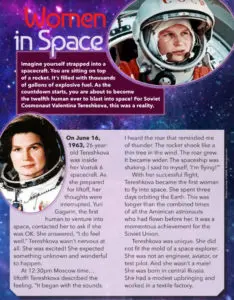
- Women have made enormous contributions to the field of Aerospace. Read about some of these amazing women in the TryEngineering Together article, Women in Space.
Global Impact: Exploring Space Technology
Aerospace engineers have had impacts on many industries all over the world. In addition to the obvious support to travel and transportation of goods via flight, their contributions to space technology have had impacts on many fields, including manufacturing, materials development, robotics, scientific instrumentation, computing, virtual reality and 3-D printing.
Throughout its history, the space station has also served as a hub for communications research and development. From 2012 to 2019, the SCaN Testbed provided communications engineers with a platform to study space-based applications of software-defined radios. The Testbed researched innovations like cognitive communications, space-based GPS, and Ka-band communications!
As you can imagine, there are many types of engineers working together to make this new underground line a reality. You can read about several people contributing to this project here to see what their work is like!
Find out more:
Get Involved
Keep Learning
Dig deeper into topics related to aerospace engineering that interest you! Check out the IEEE TryEngineering Tuesday: Aerospace student guide for a robust list of aerospace activities and resources. Also learn how you can earn a digital badge! See a few of the activities below.
Explore:
- The Apollo program, which successfully sent six United States crewed missions to the moon, did much more than propel humans into space. It sparked an array of modern inventions sold for commercial use today. Check out the “20 Inventions We Wouldn’t Have Without Space Travel” infographic from NASA. What invention are you most surprised by?
- Read about the famous United States Apollo 11 mission to the moon in the TryEngineering Together article, Apollo 11: The Eagle Has Landed.
- Learn about Radar, its history and connection to aircrafts, ships and weather
- Check out Curiosity on robotics.IEEE.org, a robotic rover that landed on Mars in August 2012.
- Read about NASA’s Lucy Mission and Lucy’s story.
- Read NASA’s How Rockets Work!
- TryEngineering News Blog: Aerospace
Watch:
- Aerospace Engineering: Think TVPBS interviews several women aerospace engineers
- What is Aerospace Engineering?
- Rocketry Challenge 2019
Try it Out:
- Try one of the TryEngineering lessons that focuses on aerospace engineering:
- Try this Build a Coffee-Can Radar activity from MIT and IEEE Spectrum
- Create a Straw Rocket or Balloon Rocket by trying these lessons from NASA.
- NASA’s Citizen Science projects are collaborations between scientists and anyone interested in making important scientific discoveries.
For university students, look for internships in the field with manufacturers and component supplier, such as the summer project at Northrop Grumman.
Competitions and Events

bigstock.com/denbelitsky
Clubs, competitions, and camps are some of the best ways to explore a career path and put your skills to the test in a friendly-competitive environment.
Clubs:
- Many schools at the pre university level offer rocketry courses or after school clubs for hands on launching – see what your community offers.
- Space Generation
- At a university there are many more opportunities to meet with like-minded students to explore aspects of aerospace engineering. Examples are:
- MIT Flying Club or MIT Rocket Team – explore their projects here
Competitions:
- FIRST Robotics Competition
- European Rocketry Challenge
- International Rocketry Challenge
- Team America Rocketry Challenge
- Learn about the Lucy in Space competition to spur an understanding of human exploration and discovery.
- NASA Solve offers multiple challenges for citizen scientists!
Camps:
- TryEngineering Summer Institute: Attend the TryEngineering Summer Institute to further your core engineering skills.
- Minority Introduction to Engineering and Science, Cambridge US: MIT program for senior preuniversity students who select five of 14 rigorous academic courses to study over a six-week residential program.
Many universities offer summer engineering experiences. Reach out to your local university’s engineering department to see what they offer.
Local Connections
Did you know you can explore aerospace engineering in your community? Think about the planes that land at your closest airport. Large or small, these planes have been developed and improved by aerospace engineers. If you want to consider how aerospace engineers help connect the globe, visit Flight Radar 24 and click on the city closest to where you live.
-

bigstock.com/vichie81
How many airplanes do you think are in the sky at any given moment?
- What technology do you think is used to track planes to avoid accidents?
- What do you think is the busiest flying day each year?
- How many people do you think manage flight operations in your area? In a large travel hub like London?
- What equipment needs to be on board a plane to have it show up in the flight radar system?
Find out more:
- Explore motor maintenance tips
- US Department of Energy: How does an internal combustion engine work?
-
Groups and Associations
Be sure to reach out to professional societies focused on engineering where you live. Not all will offer membership to pre-university students, but most offer groups for university students, and certainly offer online resources to help you explore the field. Some examples of groups focusing on aerospace engineering:
- American Institute of Aeronautics and Astronautics, US
- Aerospace Industries Association, US
- American Astronautical Society, US
- Association Aéronautique et Astronautique de France, France
- Deutsche Gesellschaft für Luft- und Raumfahrt, Germany
- Hellenic Aeronautical Engineers Society, Greece
- IEEE Aerospace and Electronics Systems Society, US
- Royal Aeronautical Society, UK
Some resources on this page are provided or adapted from the US Bureau of Labor Statistics and the Career Cornerstone Center.