


Engineering Design Process
What is the Engineering Design Process?
The engineering design process (EDP) includes productive failure. You test, fail, redesign, and try again. You keep doing this until you find the best solution.
The interactive process is essential. Engineers use notebooks to sketch ideas, document iterations, and record measurements and calculations.
There can be many solutions to the same problem. Choosing the best solution depends on other factors, such as available materials, total cost, or user preferences.
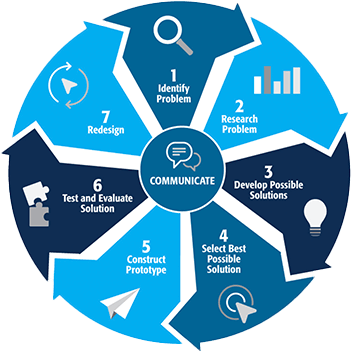
What are the Engineering Design Process Steps
- Step 1: Identify the problem: What is the problem you want to solve?
- Step 2: Research Problem: What do you know about the problem? Find out as much as you can.
- Step 3: Develop Possible Solutions: Brainstorm as many solutions as possible.
- Step 4: Select Best Possible Solution: Which of your ideas do you think is the best?
- Step 5: Construct Prototype: Using the materials given, build a prototype of your design.
- Step 6: Test and Evaluate Design: Test your design..did you satisfy the criteria?
- Step 7: Redesign: Did your design solve the problem? If not, brainstorm a new design.
Communication happens at all steps of the design process with a final presentation to share chosen solution to the design challenge.
Steps of the Engineering Design Process
Engineering Habits of Mind
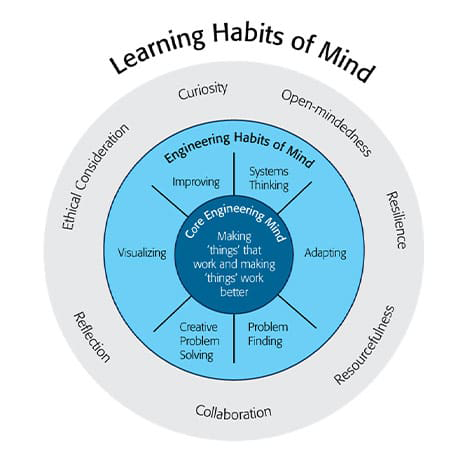
When delivering PreU STEM Outreach, we want to consider how best to cultivate the engineering habits of mind. For example, you can do a TryE hands-on activity with students.
Students will use these mindsets during the EDP steps. You can clearly explain these mindsets as you go. Highlight them during the activity when they show that “habit of mind.”
Bill Lucas and Janet Hanson wrote a paper. They are from The Center for Real World Learning at the University of Winchester in the UK. The authors named the paper “Thinking Like an Engineer.”
It discusses how to improve engineering education. It focuses on engineering habits of mind and teaching methods to improve problem-solving.
Engineering Habits of Mind (EHM) is about how engineers think everyday. The Core Engineering Mind is about making things that work and making them work better. In the paper, they identify six key engineering “habits of mind” [EHoM].
- Systems thinking: Seeing whole systems and parts and how they connect, pattern-sniffing, recognising interdependencies, synthesising
- Problem-finding: Clarifying needs, checking existing solutions, investigating contexts, verifying
- Visualizing: Being able to move from abstract to concrete, manipulating materials, mental rehearsal of physical space and of practical design solutions
- Improving: Relentlessly trying to make things better by experimenting, designing, sketching, guessing, conjecturing, thought-experimenting, prototyping
- Creative problem-solving: Applying techniques from different traditions, generating ideas and solutions with others, generous but rigorous critiquing, seeing engineering as a ‘team sport’
- Adapting: Testing, analyzing, reflecting, rethinking, both in a physical sense and mentally
The paper also discusses seven critical learning habits: (1) Open-mindedness, (2) Resilience, (3) Resourcefulness, (4) Collaboration, (5) Reflection, (6) Ethical Consideration, (7) Curiosity. See their placement, in the habits of mind image, as the outermost ring with the six habits of mind inside it.
Source: B. Lucas and J. Hanson, Thinking Like an Engineer: Using Engineering Habits of Mind and Signature Pedagogies to Redesign Engineering Education. (International Journal of Engineering Pedagogy, Vol 6, No. 2 (2016)
Click below to learn more about engineering education for school-aged children and other pre-university STEM research topics.
Discover More
Find the resources you can use to teach school-age children and how they can make the world a better place. Search for lessons, games, engineering disciplines and articles.